

Its TWOSDAY - $2 Banknote Specials - September 15th
Here is the latest edition of our weekly One day Special
The two banknotes offered this week for the special are: A Congo 1 Centime banknote from 1997, featuring a woman harvesting coffee berries on the front and the dramatic Mount Nyiragongo volcano erupting on the reverse, and the Zambia 10 Kwacha banknote from 1980, featuring the magnificent African Fish Eagle alongside President Kenneth Kaunda.
Twosday Banknote # 1:
CONGO 1 Centime (P80a) 1997
The Congo 1 Centime is one of the most historically significant banknotes to emerge from Central Africa. Issued in the aftermath of a dramatic regime change, this tiny denomination carries enormous historical weight — and two striking vignettes can be found on this banknote.
Let's break down the technical specifications, artistic design elements, and the deep cultural stories woven into this remarkable note.
Technical Specifications & Fine Details
Following the regime change of 17 May 1997, when Zaïre reverted to the Democratic Republic of the Congo and the Bank of Zaïre became the Banque Centrale du Congo, this banknote was issued.
|
|


Anatomy of the Note: Front (Obverse)
The obverse is printed in French — reflecting the DRC's official language — and features the issuing authority Banque Centrale du Congo. The design is dominated by a 5-pointed star in a diamond shape as a registration device, alongside the bank monogram.
The Main Vignette: Woman Harvesting Coffee Berries
|
The front features a woman harvesting Arabica coffee berries — a powerful symbol of the Congo's agricultural heritage. The DRC is one of Africa's most important coffee-producing nations, with Arabica grown in the highland regions of the east, including the slopes of the very volcanoes depicted on the reverse. Coffee has been central to the Congolese economy for generations, and its inclusion on the nation's currency reflects its deep cultural and economic significance. |
 |

Anatomy of the Note: Back (Reverse)
The reverse shifts to one of the most dramatic natural spectacles on Earth — a volcano so active it has permanently changed the landscape of Central Africa.
The Main Vignette: Mount Nyiragongo Erupting
|
The reverse features Mount Nyiragongo erupting — one of the world's most active and dangerous volcanoes, located in the Virunga Mountains of eastern DRC near the city of Goma. Nyiragongo is home to one of the world's only permanent lava lakes, which sits within its summit crater. When the volcano erupted in 2002, lava flows reached the city of Goma in under 30 minutes, displacing hundreds of thousands of people. The volcano also erupted dramatically in 2021. Arabica coffee berries are also featured on the reverse, linking the agricultural and geological identity of the region. |
 |
Security Features
UV Features
Under ultraviolet light, the Congo 1 Centime reveals hidden security elements, paper threads, not visible to the naked eye — a fascinating feature for collectors with a UV lamp.

The Okapi Watermark
The watermark features a repeating Okapi heads pattern. The Okapi (Okapia johnstoni) is one of the world's most extraordinary and elusive mammals — found only in the dense Ituri Rainforest of the DRC. Often called the "forest giraffe," the Okapi is the closest living relative to the giraffe despite its zebra-striped legs. It is the national animal of the DRC and appears on the country's coat of arms, making it a deeply symbolic choice for a security watermark.

Geographic and National Identity
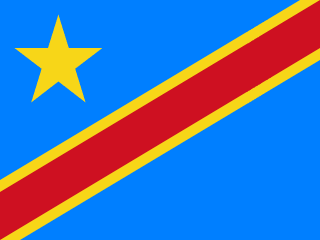
The National Flag
The flag of the Democratic Republic of the Congo features a sky-blue field with a diagonal red stripe bordered by thin yellow stripes, and a yellow star in the upper left corner:
Blue represents peace.
Red represents the blood of the country's martyrs.
Yellow represents the country's wealth.
Geographic Location Map
The Democratic Republic of the Congo is the largest country in Sub-Saharan Africa, covering 2.3 million square kilometres. It is home to the Congo Rainforest — the second largest tropical rainforest in the world after the Amazon — and contains some of the planet's richest mineral and biodiversity resources.

This 1997 Congo 1 Centime (P80a) was issued at a pivotal moment in Congolese history — the birth of a new republic from the ashes of Mobutu's Zaïre. With its stunning Nyiragongo volcano reverse and coffee harvest obverse, it is a remarkable snapshot of the DRC's natural and cultural identity.
🛒 Congo 1 Centime — Special Over
Twosday Banknote # 2:
ZAMBIA 10 Kwacha (P26e) 1980
The Zambia 10 Kwacha is a beautifully composed banknote from one of Southern Africa's most stable post-independence nations. Featuring two of Zambia's most powerful symbols — its national bird and its founding president — this note tells the story of a young nation building its identity with pride.
Here we look closer at the technical specifications, artistic design elements, and the cultural significance of this classic Southern African banknote.
Technical Specifications & Fine Details
|
|


Anatomy of the Note: Front (Obverse)
The obverse is printed in English and features the Bank of Zambia issuing authority text, the Zambian coat of arms, and decorative flowers alongside the two dominant vignettes — the Fish Eagle and President Kaunda.
The Main Vignette: African Fish Eagle
|
The African Fish Eagle (Haliaeetus vocifer) is Zambia's national bird and one of the most iconic raptors on the African continent. Known for its distinctive white head and chestnut body, the Fish Eagle is equally famous for its haunting, far-carrying call — widely regarded as the quintessential sound of Africa. Found near large bodies of water across sub-Saharan Africa, it hunts fish by swooping down and snatching them from the surface with its powerful talons. Its call is so deeply associated with the African wilderness that it has been used in countless films and documentaries to evoke the spirit of the continent. |
|

The Portrait: President Kenneth Kaunda
The obverse also features a portrait of President Kenneth Kaunda (1924–2021) — Zambia's first president and founding father, who led the country from independence in 1964 until 1991. Known affectionately as KK, Kaunda was a towering figure of African independence movements and was renowned internationally for his advocacy of non-violence and his deep Christian faith. He governed Zambia for 27 years, overseeing the nation's transition from British colonial rule to self-governance.

Anatomy of the Note: Back (Reverse)
The reverse features one of Zambia's most recognizable institutions — a symbol of the young nation's economic sovereignty.
The Main Vignette: Bank of Zambia Building
|
The reverse features the Bank of Zambia headquarters in Lusaka — the central bank established at independence in 1964 to manage the new nation's monetary policy and currency. The building's depiction on currency was a deliberate statement of economic self-determination — Zambia controlling its own financial destiny after decades of colonial rule. The Bank of Zambia has overseen multiple currency reforms since independence, including the introduction of the new Kwacha in 2013. |
|

Geographic and National Identity
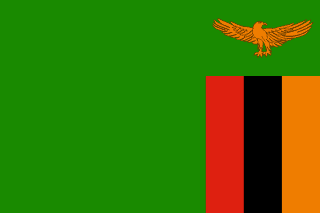
The National Flag
The flag of Zambia features a green field with a vertical tricolour of red, black, and orange on the right side, and an orange Fish Eagle in flight above the tricolour:
Green represents Zambia's natural resources and vegetation.
Red represents the struggle for freedom.
Black represents the people of Zambia.
Orange represents the country's mineral wealth, particularly copper — Zambia is one of the world's largest copper producers.
Geographic Location Map
Zambia is a landlocked country in Southern Africa, bordered by eight countries including Tanzania, Malawi, Mozambique, Zimbabwe, Botswana, Namibia, Angola, and the DRC. It is home to Victoria Falls — one of the world's largest waterfalls — and the Zambezi River, from which the country takes its name.

This Zambia 10 Kwacha (P26e) captures its monetary history and culture by showcasing its Fish Eagle, founding president, and Bank of Zambia building.
🛒 Zambia 10 Kwacha — Special Over
Enjoyed Reading About These Notes?
We'd love to hear from you! Which of these two notes caught your eye — the dramatic Nyiragongo volcano and coffee harvest heritage of the Congo, or the majestic Fish Eagle and founding president of Zambia?
Is there a specific banknote or country you would like to know more details about?
Leave a comment below and let us know 👇
1 comment
Samantha Beaulieu
The note that catched my eye , was the note with the Volcano and the Coffee Harvest because I find it to have more details and it’s more colorful.