

Twosday August 25th $2 Banknote Specials
Welcome to the this weeks edition of a weekly special I will be offering for one (1) day ONLY each Tuesday
The two banknotes offered this week for the special are: An Macedonia 10 Dinara note from 2018, and another vintage note, the Eritrea 1 Nakfa banknote from 1984.
Twosday Banknote # 1:
MACEDONIA 10 Dinara (B217a) 2018
Few collectibles capture a nation's soul quite like its currency. The 2018 Macedonia 10 Dinara polymer banknote (B217a / Pick #25) is a perfect example — a compact, modern note that punches well above its denomination. Part of Macedonia's transition to durable polymer printing, it showcases treasures from the ancient world: a 4th-century BC golden earring and a rare alabaster statue of the Egyptian Goddess Isida found on Macedonian soil.
What makes this note special isn't just its modern polymer construction — it's the 2,300-year-old story it tells. Below, we break down the technical details, the artistry of its design, and the remarkable cultural history behind this little purple gem.
Technical Specifications & Fine Details
This particular 10 Dinara note was manufactured as part of Macedonia's transition from paper to modern polymer currency, introduced in May 2018.
- Catalog Number: B217a
- Year of Issue: 2018 (Introduced 15.05.2018)
- Dimensions: 126 x 63 mm
- Material: Polymer
- Watermark: Simulated windowed security thread with repeating bank initials HBPM
- Security Features: Shadow-gold filigree, simulated security thread, and polymer substrate durability.
- Printer: Produced by De La Rue (one of the world's leading security printers, renowned for producing banknotes for over 140 countries).
- Signatures: Sig. 7: Bogov | Prefix AA–AV
- Color Palette: A vibrant blend of purple tones with gold filigree accents.

Anatomy of the Note: Front (Obverse)
The front of the banknote blends ancient Macedonian artistry with classical Mediterranean heritage.
Text and Languages
The text on the note is rendered in Macedonian, identifying the issuing authority — Народна Банка на Република Македонија (National Bank of the Republic of Macedonia).
The Security Filigree
A striking shadow-gold filigree reproduction of a 4th-century BC earring anchors the obverse design — a nod to the extraordinary goldsmithing tradition of ancient Macedonia.
The Main Vignette: Goddess Isida
At the heart of the obverse sits a reproduction of a 3rd-century BC alabaster statue of the torso of the Egyptian Goddess Isida, discovered in Ohrid — a stunning reminder of the ancient cross-cultural connections between Macedonia and the wider Mediterranean world.
Egyptian Goddess Isida
Isis (originally Aset or Isida) is one of the most powerful and enduring goddesses of ancient Egypt. She represents motherhood, magic, healing, and protection, eventually becoming a universal deity whose worship spread across the entire Roman Empire.
Core Mythology and Powers
- The Resurrection of Osiris: Isis is best known for resurrecting her murdered husband, Osiris. After his brother Set tore his body to pieces, Isis utilized her powerful magic to find the fragments, reassemble them, and briefly breathe life back into him.
- The Mother of Horus: Through her magical resurrection of Osiris, she conceived her son, Horus. She fiercely protected the infant Horus in the marshes of the Nile Delta until he grew up to avenge his father and claim the earthly throne.
- Goddess of Magic (Heka): Isis was considered more clever and magically potent than a million ordinary gods. She famously tricked the supreme sun god, Ra, into revealing his secret name, which granted her ultimate cosmic authority.
- Universal Reach: By the Greco-Roman period, she absorbed the traits of many other goddesses. She became a patron to sailors, rulers, and everyday people alike, with major temples dedicated to her as far away as Rome, Greece, and Pompeii.

Anatomy of the Note: Back (Reverse)
The reverse side shifts focus from ancient sculpture to the breathtaking world of Byzantine floor art — a stunning mosaic that has survived nearly 1,500 years beneath Macedonian soil.
The Main Vignette: The Stobi Peacock Mosaic
The back features a reproduction of the magnificent peacock floor mosaic from the 5th–6th century AD baptisteries of the Episcopal Basilica in Stobi — one of the most celebrated archaeological sites in North Macedonia.
Historical Insight: The Stobi Mosaics
The ancient city of Stobi was one of the most important Roman and early Christian cities in the Balkans, situated at the confluence of the Crna and Vardar rivers.
- The Episcopal Basilica: Built in the 4th century AD and expanded through the 6th century, this grand Christian basilica served as the seat of the Bishop of Stobi. Its floors were covered in elaborate polychrome mosaics — among the finest examples of early Byzantine craftsmanship ever discovered.
- The Peacock Symbol: In early Christian iconography, the peacock was a powerful symbol of immortality and resurrection — its flesh was believed by ancient writers to be incorruptible. Depicting a peacock in a baptistery was deeply intentional, representing the eternal life promised through baptism.
- Artistic Mastery: The mosaic's intricate tesserae — tiny hand-cut pieces of stone and glass — create a vivid, almost luminous peacock with a dramatically fanned tail. The level of detail and colour preservation after 1,500 years is extraordinary, making it a crown jewel of Macedonian heritage.
- A Living Legacy: By placing this mosaic on the reverse of the 10 Dinara note, Macedonia honours both its Roman past and its early Christian heritage — a reminder that this small nation sits at one of history's great cultural crossroads.
Geographic and National Identity
To fully appreciate the context of this banknote, it helps to visualize the nation from which it emerged. Below are the official geographic and national symbols of North Macedonia:
The National Flag
The bold red and yellow sun flag represents the sovereign identity of the Macedonian people — the golden sun of liberty with eight broadening rays stretching to the edges of the flag.

Geographic Location Map
Situated in the heart of the Balkan Peninsula, North Macedonia is a landlocked nation bordered by Serbia, Kosovo, Bulgaria, Greece, and Albania. Its strategic position at the crossroads of ancient trade and military routes made it one of the most culturally layered regions in European history.

This exceptional 2018 Macedonia 10 Dinara polymer note (B217a) is a must-have for collectors focusing on Balkan history, Byzantine art, polymer currency varieties, or ancient Mediterranean connections. A tiny note with a monumental story.
Add this piece of history to your collection today at the special price.
🛒 Macedonia 10 Dinara — Special Ended
Twosday Banknote # 2:
ERITREA 1 Nakfa (B101a / P1) 1997
Some banknotes carry the weight of an entire nation's birth. The 1997 Eritrea 1 Nakfa (B101a / P1) is one of them — the very first banknote ever issued by the State of Eritrea, printed just four years after the country won its independence from Ethiopia after a gruelling 30-year war. This modest note is not just currency; it is a declaration of existence.
Below, we break down the technical details, the powerful imagery on its faces, and the remarkable story of the nation that created it.
Technical Specifications & Fine Details
Every banknote tells a story through its production. This 1 Nakfa note was part of Eritrea's inaugural banknote series — the first currency printed for a brand new nation.
- Catalog Number: P1
- Year of Issue: 1997 (24.05.1997)
- Dimensions: 140 x 70 mm
- Material: High-quality security paper
- Watermark: Camel head
- Printer: Produced by Giesecke & Devrient (the renowned German security printer responsible for banknotes across dozens of nations).
- Signatures: Sig. 1: Afewerki / Beyene | Prefix AA–AP
- Color Palette: A warm blend of olive-green and brown tones.

Anatomy of the Note: Front (Obverse)
The front of this historic note blends the pride of a hard-won independence with the everyday symbols of Eritrean life and culture.
Text and Languages
The note carries text in three languages — Arabic, English, and Tigrinya — reflecting Eritrea's diverse population and its intent to be recognized on the world stage from day one.
The Main Vignette: EPLF Flag Raising & Triptych Portrait
The obverse features a powerful scene of Eritrean fighters raising the EPLF flag — a direct reference to the moment of liberation. Alongside this sits a triptych portrait representing the people of Eritrea, with a camel serving as the registration device — a nod to the animal that has been central to Eritrean trade and survival for centuries.
The Cultural Weight: Eritrea's Fight for Independence
To understand why this banknote matters, you need to understand what it took to create it.
- 30 Years of War: Eritrea fought one of Africa's longest independence wars against Ethiopia from 1961 to 1991. The Eritrean People's Liberation Front (EPLF) ultimately prevailed, and in 1993 Eritrea became Africa's newest nation by referendum.
- The Nakfa: The currency itself was named after the town of Nakfa — the EPLF's mountain stronghold that was never captured during the entire war. Naming the currency after it was a deliberate act of national pride.
- The Camel: Featured on both sides of the note, the camel is far more than decoration. It was the backbone of EPLF supply lines during the war — carrying ammunition, food, and medicine through terrain no vehicle could navigate. The camel is a national symbol of resilience.
- A Nation's First Note: Issued on May 24, 1997 — the 4th anniversary of Eritrean independence — this 1 Nakfa note was part of the very first set of banknotes ever printed for the country. Holding one is holding a piece of a nation's birth certificate.

Anatomy of the Note: Back (Reverse)
The reverse side continues the themes of Eritrean daily life and national identity, framed by text in all three official languages.
The Main Vignette: Children in an Outdoor Classroom
The back features a camel alongside a scene of children studying in an outdoor classroom — a deeply intentional image. During the independence war, the EPLF ran schools in the field for fighters and civilians alike. Education was considered an act of resistance. Placing it on the nation's first banknote was a statement: Eritrea would be built on knowledge.
Geographic and National Identity
To fully appreciate the context of this banknote, it helps to visualize the nation from which it emerged. Below are the official geographic and national symbols of Eritrea:
The National Flag
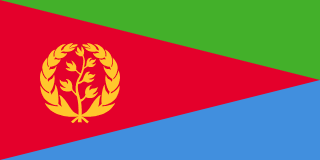
The bold green, blue, and red flag of Eritrea features a golden olive wreath — the same emblem carried by the EPLF during the independence struggle. Every colour tells a story: green for agriculture, blue for the Red Sea coast, and red for the blood shed for freedom.
Geographic Location Map
Situated on the Horn of Africa along the Red Sea coast, Eritrea borders Ethiopia, Sudan, and Djibouti. Its strategic coastal position made it a prize fought over by colonial powers and neighbouring nations alike — and ultimately the reason its people were willing to fight for 30 years to keep it.

This exceptional 1997 Eritrea 1 Nakfa (B101a / P1) is a must-have for collectors focusing on African independence history, first-issue banknotes, or the Horn of Africa. There is no more powerful a collectible than a nation's very first note.
Add this piece of history to your collection today at the special price.