

Twosday August 18th $2 Banknote Specials
Welcome to the first edition of a weekly special I will be offering for one (1) day ONLY each Tuesday
The two banknotes offered this week for the special are: An Afghanistan 500 Afghanis note from 1991, and another vintage note, the Brazil 100 Cruzeiros banknote from 1984.
Twosday Banknote # 1:
AFGHANISTAN 500 Afghanis (P60c) 1991
The study of paper money offers a fascinating window into geopolitics, art, and national identity. A prime example is the 1991 Afghanistan 500 Afghanis banknote (Catalog Ref: Pick #60c). Issued during a period of massive political transition, this note acts as a cultural time capsule. It captures both the ancient traditions and the enduring strongholds of the Afghan people.
Here, we break down the technical specifications, artistic design elements, and the deep cultural stories woven into this remarkable piece of currency.
Technical Specifications & Fine Details
Every banknote tells a story through its production. This particular 500 Afghanis note was manufactured during the final years of the Republic of Afghanistan before the mid-1990s civil conflicts.
- Catalog Number: Pick #60c
- Year of Issue: 1991
- Dimensions: 150 x 66 mm
- Material: High-quality security paper
- Watermark: None
- Security Features: Features a solid embedded security thread.
- Printer: Produced by Goznak (the state-owned enterprise responsible for printing Soviet, Russian, and allied nations' currency, known for its high-detail engraving).
- Color Palette: A rich blend of green, brown, and blue undertones.
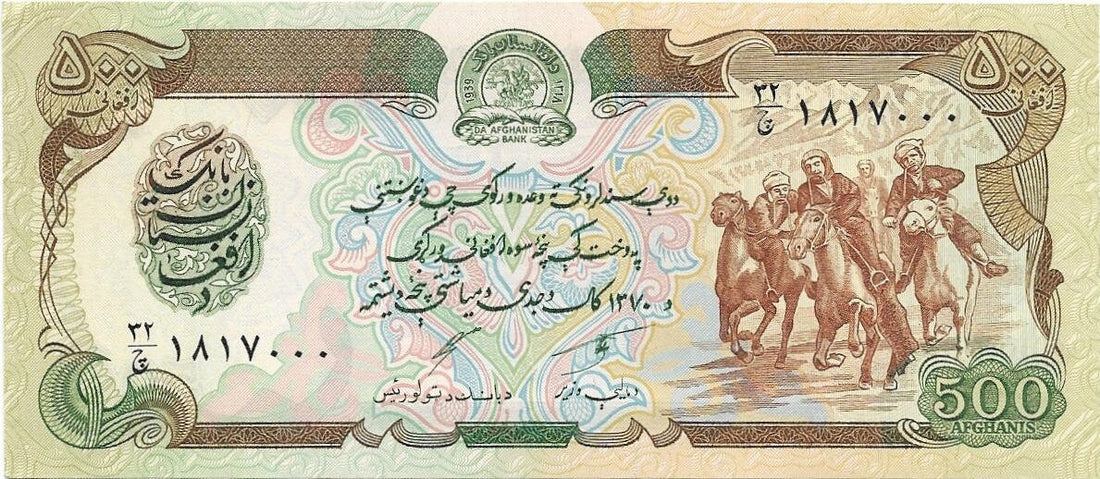
Anatomy of the Note: Front (Obverse)
The front of the banknote blends official state symbolism with traditional Afghan life.
Text and Languages
The text on the note is rendered in both Pashto and English, serving both local utility and international banking recognition.
The Bank Seal
The official central bank seal is rich with classical imagery, featuring:
- Horsemen: Signifying strength and historical mobility.
- Cornucopia: A traditional symbol of abundance and agricultural prosperity.
- Ancient Coins: A nod to Afghanistan's deep numismatic history as a crossroads of the ancient Silk Road.
The Main Vignette: Buzkashi
Below the seal, the primary artwork captures dynamic action: men on horseback engaged in the fierce sport of Buzkashi.
The Cultural Weight of Buzkashi
The inclusion of Buzkashi (literally translating to "goat dragging" from Persian) on national currency emphasizes its status as Afghanistan's national sport.
- The Mechanics: In Buzkashi, highly skilled horsemen known as Chapanandazan compete to seize a headless goat or calf carcass. They must maneuver it across a massive open field, push past fierce rivals, and drop it cleanly into a designated scoring circle called the "Circle of Justice."
- Symbol of Identity: For the Afghan people, Buzkashi is not merely a game—it is a living mirror of their history. It demands legendary horsemanship, fierce independence, immense physical strength, and strategic cunning.
- Societal Importance: Historically funded by powerful regional leaders or khans, mastering the game brought immense honor to a rider's family and community. It represents a proud preservation of the Central Asian nomadic warrior spirit, celebrating bravery and resilience in the face of brutal competition.

Anatomy of the Note: Back (Reverse)
The reverse side shifts focus from cultural sports to national architectural resilience, framed by bilingual English and Pashto text.
The Main Vignette: Bala Hissar
The back features a detailed engraving of the Bala Hissar, the famous "High Fortress" looking down upon the capital city of Kabul.
Historical Insight: The Bala Hissar (High Fortress)
The Bala Hissar is an ancient citadel with roots stretching back as far as the 5th century A.D., if not earlier.
- The Guard of Kabul: Built upon a hill overlooking the city, it historically served as the primary defensive stronghold and the fortified residence for Afghan emperors and royal families. Its thick stone walls have witnessed the rise and fall of multiple empires.
- A Witness to Conflict: Given its supreme strategic vantage point, the fortress was a central battleground during the First and Second Anglo-Afghan Wars. It was partially destroyed, rebuilt, and modified over successive generations.
- Modern Resilience: Even today, the Bala Hissar remains a potent symbol of Kabul's endurance. Its inclusion on the 1991 banknote serves as a reminder of the country's ability to withstand centuries of shifting geopolitical tides.
Geographic and National Identity
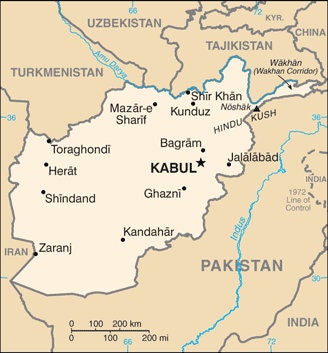
To fully appreciate the context of this banknote, it helps to visualize the nation from which it emerged. Below are the official geographic and national symbols of Afghanistan:
The National Flag
The historic flag represents the heritage and sovereign identity of the Afghan people.

Geographic Location Map
Situated in Central/Southwest Asia, Afghanistan's rugged terrain—dominated by the Hindu Kush mountains—has historically shaped its isolated communities and proud warrior traditions.
This exceptional 1991 500 Afghanis note (P-60c) is a must-have for collectors focusing on Central Asian history, Goznak print varieties, or equestrian-themed currency, animal notes or Afghanistan banknotes and varieties.
Add this piece of history to your collection today at the special price.
Twosday Banknote # 2:
BRAZIL 100 Cruzeiros (P198b) 1984
The second note featured is the 1984 Brazil 100 Cruzeiros banknote (Catalog Ref: Pick #198b). Issued during a pivotal era of economic change and transition in Brazil, struggling with hyper-inflation. Its unique mirrored design captures both the imperial military heritage and historical milestones of the Brazilian people.
Breaking down the technical specifications, artistic design elements, and cultural significance of this banknote.
Technical Specifications & Fine Details
Every banknote tells a story through its production. This particular 100 Cruzeiros note was manufactured as part of the second edition series circulating in the early-to-mid 1980s.
- Catalog Number: Pick #198b
- Year of Issue: 1984 (Undated issue)
- Dimensions: 154 x 74 mm
- Material: High-quality security paper
- Watermark: Features a clear profile portrait of the Duke of Caxias.
- Security Features: Advanced fine-line background engraving.
- Printer: Produced by the Casa da Moeda do Brasil (The Brazilian Mint located in Rio de Janeiro, legendary for its precise execution of security details).
- Color Palette: A vibrant blend of teal, blue, olive-green, and multi-colour undertones.
- Signatures: Features the official signatures of Ernane Galvêas and Affonso Celso Pastore.

Anatomy of the Note: Front (Obverse)
The front of the banknote utilizes a distinctive, innovative design layout with mirrored, inverted text along the vertical axis. It perfectly blends official state imagery with celebrated historical leadership.
Text and Languages
The text on the note is rendered entirely in Portuguese, denoting its denomination and the national authority of the Banco Central do Brasil.
The Main Vignette: Duke of Caxias
At the center of the obverse sits the detailed portrait of Luís Alves de Lima e Silva, universally recognized as the Duque de Caxias (Duke of Caxias).
The Historical Weight of the Duke of Caxias
The inclusion of the Duke of Caxias (1803–1880) on national currency emphasizes his status as one of Brazil's greatest military heroes and politicians.
- The Soldier King: Rising from a young officer to the commander of the Imperial Brazilian Army, he fought alongside Emperor Dom Pedro II to consolidate power and maintain national sovereignty during the 19th century.
- The Peacemaker: Nicknamed "O Pacificador" (The Peacemaker), Caxias earned legendary status for his strategic cunning and empathy. Rather than obliterating domestic rebellions, he focused on diplomatic pacification, re-integrating breakaway provinces back into the Empire with minimal bloodshed.
- Patron of the Army: Today, his legacy is deeply woven into the identity of modern Brazil. He is celebrated as the official patron of the Brazilian Army, with his birthday recognized annually as Soldiers' Day across the nation.

Anatomy of the Note: Back (Reverse)
The reverse side carries forward the mirrored visual format. It shifts the focus from leadership to a historic depiction of military strategy, framed by the signatures of the monetary council.
The Main Vignette: Internal Pacification
The back features a grand, dynamic engraving depicting a pitched 19th-century battle sequence representing Internal Pacification.
Historical Insight: The Pacification Battles
- The artwork immortalizes the era of imperial integration, highlighting the heavy structural sacrifices required to keep a vast nation unified.
- The Visual Clashes: The layout displays charging horsemen, unsheathed sabers, and coordinated infantries locked in battle. It captures the fierce reality of historical conflicts like the Ragamuffin War (Guerra dos Farrapos) or the Balaiada revolt.
- A Message of Unity: Rather than glorifying the destruction of civil war, the vignette honors the tactical restoration of law, order, and regional alignment.
- Modern Resilience: For collectors, this scene reflects the ultimate consolidation of Brazil's sweeping modern borders. It is a stunning visual reminder of the country's complex journey from a fragmented Portuguese colonial territory to a massive, united federal republic.
Geographic and National Identity
To fully appreciate the context of this banknote, it helps to visualize the nation from which it emerged. Below are the official geographic and national symbols of Brazil:
The National Flag
The historic green and yellow flag represents the rich natural fields, golden resources, and sovereign identity of the Brazilian people.

Geographic Location Map
Situated as the largest country in South America, Brazil's expansive territory—dominated by the Amazon basin and dense highlands—has historically shaped its distinct regional identities and diverse cultural heritage.

This exceptional 1984 100 Cruzeiros note (P-198b) is a must-have for collectors focusing on South American banknotes or history, military themed currency, or the masterpieces of Brazil.
Add this piece of history to your collection today at the special price.